



The integration of Artificial Intelligence (AI) into the commercial landscape continues to drive regulatory developments across multiple sectors in Thailand. As AI adoption expands, the Office of the Consumer Protection Board (OCPB) is one of the leading Thai authorities in paying closer attention to sector-specific implications. Consumer protection is one area where regulators have begun taking a more active approach in relation to both the use of AI in commercial activities and the adoption of AI-driven enforcement tools by regulators themselves.
In this newsletter, we highlight recent developments from the OCPB that business operators should closely monitor from a consumer protection and digital compliance perspective.
1. Regulatory Requirements for AI-Generated Content in Advertising
In late 2025, the OCPB issued the “Guidelines on Advertisement of Goods or Services which May Cause Misunderstanding in Material Facts” under the Consumer Protection Act B.E. 2522 (1979). Aiming to protect consumers’ rights, these Guidelines prohibit use of “contents which are unfair to consumers or potentially harmful to the public” in advertisement, including use of AI-edited images.
The guidelines focus on two primary areas aimed at preventing consumer misunderstanding of material facts:
(i) advertisements utilizing AI technology or image-editing software, and
(ii) advertisements for inedible food imitations.
For business operators utilizing AI technology or image-editing programs to create or modify advertising content, the OCPB mandates the following compliance measures:
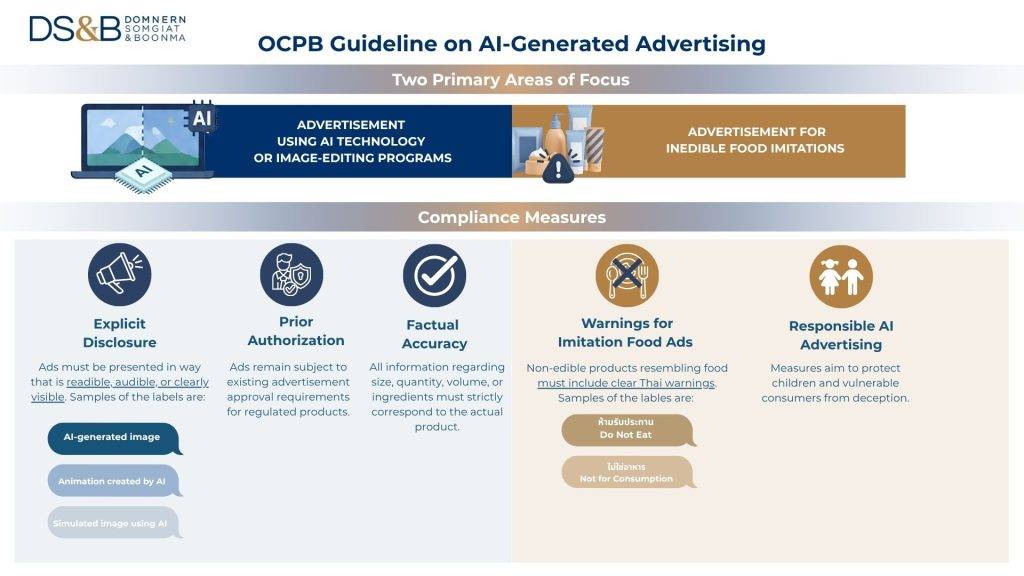
Apart from AI-generated advertisement, these Guidelines have also highlighted specific risks regarding “imitation food” advertisements that are non-edible. Such advertisements must carry clear warnings (e.g., “Do Not Eat,” “Not for Consumption”) in Thai, ensuring that children and vulnerable consumers are not misled. These measures emphasize that while creative AI use is permitted, it must be balanced with consumer transparency and responsible advertising practices.
2. OCPB Big Data and AI Governance:
The OCPB is no longer just a regulator on use of AI by business operators but also a sophisticated user of AI for protecting the consumers. In April 2026, the agency launched Phase 1 of the OCPB Big Data project, themed “CONNECTED DATA FOR CONSUMER CARE,” which includes the following initiatives:
To ensure these technologies are used responsibly, the OCPB officially issued its Artificial Intelligence Governance Policy (AI Governance) on April 22, 2026. This framework establishes clear standards for the agency’s internal digital transformation. Particularly, the policy establishes an internal AI governance structure and sets standards for ethical AI use, personal data protection, information security, prevention of bias and discrimination, and protection against intellectual property infringement in AI-generated content.
Key Takeaway
To navigate this evolving regulatory landscape, business operators should review their digital marketing practices to ensure that any content created or modified using AI technology complies with applicable disclosure and advertising requirements. This also demonstrates the OCPB’s recognition of AI’s potential for its regulatory tasks. The OCPB not only prevents misuse of AI for consumer deception but also uses AI to enhance consumer protection.
More broadly, these developments suggest that Thai regulators are moving beyond traditional reactive enforcement toward a more technology-enabled and proactive consumer protection model. As AI governance frameworks and technology-driven regulatory measures continue to develop, businesses should expect increased regulatory attention in relation to the use of AI in commercial activities and broader digital compliance obligations. We will continue to monitor these developments and provide further updates as the regulatory landscape evolves.
 Share
Share

